
Walk past a struggling garden bed and the usual advice is the same: add nitrogen. But here's the thing most people never hear — there's often plenty of nitrogen already in the soil. It's just locked up where roots can't reach it: inside the bodies of bacteria. Getting it back out is a job for some of the smallest predators on Earth.
That job belongs to the protozoa — and once you understand what they do, you'll never look at a shovel of living compost the same way again.
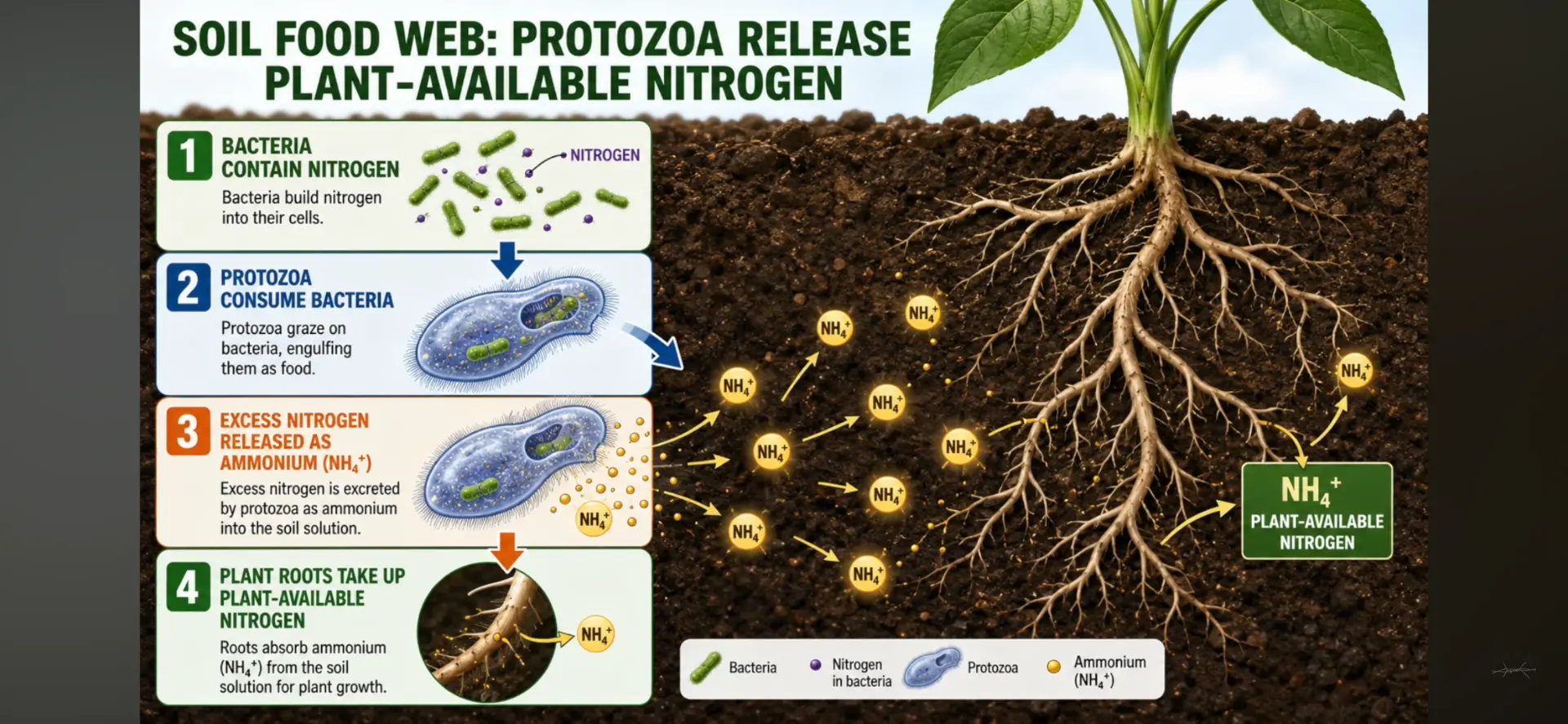
Step 1: Bacteria lock up the nitrogen
Bacteria are the soil's great decomposers. They swarm over organic matter — old roots, fallen leaves, compost — and break it down, absorbing carbon and nitrogen from the soil solution as they go. A bacterium needs roughly one atom of nitrogen for every five atoms of carbon in its body (a carbon-to-nitrogen ratio of about 5:1), and it will scavenge every bit of nitrogen it can find to build those cells.
This is wonderful and terrible at the same time. Wonderful, because bacteria concentrate nutrients and keep them from leaching away with irrigation or rain. Terrible, because as long as the nitrogen sits inside a bacterium, your plants can't use it. In soil that's all bacteria and no predators, nitrogen is in the pantry but the pantry is locked.
Step 2: Protozoa come hunting
Enter the protozoa — the single-celled predators of the soil food web. There are three main groups, each with its own hunting style: flagellates, which swim through soil water films with a whip-like tail; amoebae, which flow around their prey and engulf it; and ciliates, the largest of the three, which use rows of tiny beating hairs to sweep bacteria in.
All three eat bacteria — enormous numbers of them. A single amoeba can consume thousands of bacteria a day, and a thriving protozoa community keeps the bacterial population young, active, and cycling.
Step 3: The nitrogen surplus comes out as plant food
Here's where the math gets beautiful. Bacteria are nitrogen-rich at about 5 parts carbon to 1 part nitrogen. But a protozoan's body runs much leaner on nitrogen — closer to 30 parts carbon for every 1 part nitrogen. So when a protozoan eats bacteria, it's taking in far more nitrogen than it could ever build into its own cells.
What happens to the surplus? The protozoan excretes it — directly into the soil water — as ammonium, written NH₄⁺. And ammonium is one of the exact forms of nitrogen plant roots absorb most easily. The predator's waste is the plant's meal.
Bacteria hold the nitrogen. Protozoa set it free. Plants collect the prize — right at the root where it's released.
Step 4: Roots feed where the action is
This exchange doesn't happen randomly across the soil. Plants actively recruit it. Roots leak sugars and proteins into the surrounding soil — a zone called the rhizosphere — which fuels dense populations of bacteria, which in turn attract grazing protozoa. The plant is essentially farming microbes at its root tips, and the ammonium is released exactly where the root can take it up immediately.
It's a delivery service no bag of synthetic fertilizer can match: slow, steady, localized, and timed by the plant's own demand.
What happens when the food web is missing
If the soil food web isn't alive — if heat, drought, salts, tilling, or chemical inputs have stripped out the protozoa — this entire release mechanism shuts down. The bacteria may still be there, still holding nitrogen, but with nothing eating them, that nitrogen stays locked. The plant goes hungry in a kitchen full of food, and the grower reaches for another bag of fertilizer to force-feed it.
This is exactly the condition we find in much of Southern California's tired, compacted soil — and it's why we test every batch of our living compost under the microscope. We don't just check that bacteria are present. We confirm the predators are too: flagellates, amoebae, and ciliates, ready to go to work the moment they hit your soil.
How to get protozoa working in your soil
- Inoculate with living compost or a fresh compost extract — this is the direct route, because a microscope-verified product already carries the full food web, protozoa included.
- Keep the soil covered and moist — protozoa move and hunt in water films, so mulch and steady moisture keep them active.
- Skip synthetic fertilizers, fungicides, and pesticides — they crash the very populations that do this work.
- Feed with compost and gentle natural inputs like humic acid that support microbes instead of replacing them.
Curious whether your soil already has protozoa working for it? That's a question a microscope can answer. We partner with Nicola Peill-Moelter, a certified Soil Food Web Consultant, for biological soil testing — she'll count exactly what's living in your soil and tell you what's missing.
Want living microbial compost for your soil?
Microscope-verified compost and liquid extracts, made in San Diego County.